
Resources
ULI initiates research that anticipates emerging land use trends and issues, proposing creative solutions based on that research. ULI documents best practice and publishes books, reports, and case studies, to impart cumulative knowledge, sharing our resources to help the development community continuously improve its performance. ULI members have access to a wealth of resources – over 10,000 pieces of content – webinars, conferences, reports, case studies, and much more, through Knowledge Finder. You can also find the latest, timely, succinct news from ULI through Urban Land, ULI’s magazine with perspective’s on today’s issues that you can’t find anywhere else.
ULI Emerging Trends in Real Estate® Asia Pacific Outlook 2025
Emerging Trends in Real Estate® Asia Pacific 2025
What are the expected best bets for investment and development in 2025? Based on personal interviews with and surveys from 204 of the most influential leaders in the real estate industry, this forecast will give you a heads-up on where to invest, which sectors and markets offer the best prospects, and trends in the capital markets that will affect real estate. A joint undertaking between PwC and the Urban Land Institute, this 19th edition of Emerging Trends Asia Pacific is the forecast you can count on for no-nonsense, expert insight.
About Emerging Trends in Real Estate®
Emerging Trends in Real Estate® is one of the most highly regarded annual industry outlooks for the real estate and land use industry, published jointly by PwC and the Urban Land Institute. By incorporating interviews and survey responses from several hundred industry professionals, the report provides an in-depth outlook by region on real estate investment, development trends, and capital markets. The report is produced in four versions: Americas, Asia Pacific, Europe, and Global. All the Emerging Trends in Real Estate® reports published since 2003 are available on Knowledge Finder.
Read the full report on ULI’s Knowledge Finder
Find the latest content and resources from ULI Australia, including the latest edition of Residential Development Review, and recordings of webinars and conferences from ULI District Councils around the globe, on ULI’s Knowledge Finder (exclusive to ULI members only).
ULI Emerging Trends in Real Estate® Global Outlook 2025
Reflections from global industry leaders suggest a cautiously optimistic outlook for global real estate. Despite concerns over fragile economic growth and growing geopolitical uncertainty, there is a general sense that the market is at an inflection point, with investors looking to put capital to work and reposition their portfolios. The ULI Emerging Trends in Real Estate® Global Outlook 2025 examines these global challenges and opportunities facing real estate and analyses the developing impacts on regions and sectors around the world.
ULI Emerging Trends in Real Estate® Asia Pacific Outlook 2024
Emerging Trends in Real Estate® Asia Pacific 2024

In the 13 years since the global financial crisis ushered in a long era of ultra-low interest rates, real estate markets across the Asia Pacific had been pushed in the direction of a single mainstay strategy: use cheap leverage to buy core assets, ride the tailwinds of cap rate compression, then exit with generally handsome returns to one of many institutional buyers armed with a share of the region’s growing surplus of investment capital.
Today, that cycle has been broken. With interest rates in the West rising at the fastest pace ever, the old formula of leverage and cap rate compression no longer computes, forcing investors to find other ways to drive profit as markets anticipate a reset around new measures of value.
Download the Report (English)
Download the Report (Chinese)
Download the Report (Japanese)
Read the Press Release
ULI Emerging Trends in Real Estate® Asia Pacific Outlook 2023
Emerging Trends in Real Estate® Asia Pacific 2023
Although 2022 saw most Asia Pacific markets—with the exception of China—begin to shake off the effects of regional COVID restrictions, as investors look to 2023 they find themselves confronted with a different, but no less dangerous, set of threats: high inflation, rising interest rates, unsustainable levels of public- and private-sector debt, and an impending global recession.
This stagflationary combination creates an environment for which there is no modern-day playbook, and led many real estate investors in the second half of 2022 to step away from the market and wait for events to play out. As a result, third-quarter Asia Pacific transactions fell 38 percent year-on-year to a 10-year low, according to analysts MSCI.
In the end, though, investors will have to adapt to a new market reality that brings with it a number of fundamental changes.
Download the Report (English)
Download the Report (Chinese)
Download the Report (Japanese)
Read the Press release
ULI Emerging Trends in Real Estate® Asia Pacific Outlook 2022
Emerging Trends in Real Estate® Asia Pacific 2022
As real estate investors plan their 2022 post-pandemic strategies, the road ahead is fraught with uncertainty. Transactions are rebounding after nearly two years of lockdowns and travel embargoes, but the contours of the investment landscape in the Asia Pacific have been reshaped—in some ways profoundly—by pandemic-induced changes to the way we use real estate.
What are the expected best bets for investment and development in 2022? Based on personal interviews with and surveys from 334 of the most influential leaders in the real estate industry, this forecast will give you a heads-up on where to invest, which sectors and markets offer the best prospects, and trends in the capital markets that will affect real estate.
Download the Report (English)
Download the Report (Chinese)
Download the Report (Japanese)
Read the Press release
ULI Emerging Trends in Real Estate® Asia Pacific Outlook 2021
Emerging Trends in Real Estate® Asia Pacific 2021
The 2021 Emerging Trends in Real Estate® Asia Pacific report features a detailed analysis of how COVID-19 is affecting regional markets and asset classes. In particular, how has the pandemic affected transaction volumes and valuations, and what types of investment opportunities will surface going into 2021? We also look at likely secular shifts within the industry, such as how sectors like office and retail will need to be reimagined in a post-COVID world.
Download the Report (English)
Download the Report (Chinese)
Read the Press Release
Watch ’10 Emerging Trends in 100 Minutes’ on Knowledge Finder
ULI Emerging Trends in Real Estate® Asia Pacific Outlook 2020
Emerging Trends in Real Estate® Asia Pacific 2020
What are the best bets for investment and development in 2020? Based on personal interviews with and surveys from 463 of the most influential leaders in the real estate industry, this forecast will give you a heads-up on where to invest, which sectors and markets offer the best prospects, and trends in the capital markets that will affect real estate. A joint undertaking between PwC and the Urban Land Institute, this 14th edition of Emerging Trends Asia Pacific is the forecast you can count on for no-nonsense, expert insight.
Download the Report (English)
Download the Report (Chinese)
Download Press Release
ULI Emerging Trends in Real Estate® Asia Pacific Outlook 2019
Emerging Trends in Real Estate® Asia Pacific 2019
“Both in terms of rent and capital values around the region, we’re near the top of the cycle”
After nine years of relentless expansion, Asia’s real estate markets are facing rising headwinds. An impending trade war, rising interest rates, tighter access to credit, and buyer fatigue at sky-high prices for both commercial and residential properties are causing investors to question whether the long bull cycle may be reaching its peak: “The market’s wobbling like a jelly on a plate,” as one investor put it. “We’re at historic highs across the board.”
That said, market fundamentals in 2018 remain robust. Transactions for the year are at record levels and pricing is strong, sustained by ever-growing volumes of institutional capital piling up in Asia’s biggest economies.
For now, then, the music continues, and although some investors are looking to sell down their holdings and reposition, the sheer weight of capital looking to find a home in real estate means that prices may not fall significantly even if other indicators turn south.
As a result, and as in previous years, investors must consider more varied strategies than in the past to get money into the market.
Download the Report (English)
Download the Report (Chinese)
Download the Report (Japanese)
Download Press Release
ULI Emerging Trends in Real Estate® Asia Pacific Outlook 2018
Emerging Trends in Real Estate® Asia Pacific 2018

This year’s investment prospect rankings reflect the growing divergence between investment strategies as buyers pursue either growth- or yield-driven approaches. Cities that are the biggest gainers in this year’s survey are those where investors seek to maximize returns via rental growth (Sydney and Melbourne), those that look for returns that are safe and low, but still higher than yields on sovereign bonds (Tokyo), or those that tap long-term secular growth in emerging markets (Vietnam). In addition, there was a resurgence in investor sentiment toward Singapore, which appears to have found a market bottom in both the office and residential sectors.
In terms of prospects for individual property types, logistics assets take pole position this year, with investors showing renewed confidence in a story of long-term structural undersupply.
Download the Report (EN Version)
Download the Report (CN Version)
Download the Press Release
ULI Emerging Trends in Real Estate® Asia Pacific Outlook 2017
Emerging Trends in Real Estate® Asia Pacific 2017

Industry Sees Fewer Transactions as Yields Continue to Slip
Whilst demand is strong in Asia Pacific, the supply of core product is thinner than ever. The low transaction volumes in the first six months of 2016 come as owners opt instead to refinance properties at lower rates instead of selling them. Yields are falling but looking forwards, while most investors see potential for some further compression – mainly as a result of the sheer weight of new capital being pointed at the sector – the trend may be reaching its limit.
Bangalore and Mumbai Ranked as Top Real Estate Investment Markets
Now in its 11th edition, this year’s Investment Prospects survey shows a strong shift away from last year’s favorites, which featured core markets in Japan and Australia. Instead it favors emerging-market destinations, with two Indian cities topping a list which also includes Vietnam and the Philippines. This overarching shift reflects the difficulty in sourcing core assets in an environment where owners have few other places to invest their capital if they sell, together with the growing urgency of investors’ ‘quest for yield’ as returns are squeezed ever lower.
Download the Report (EN version)
Download the Report (Chinese version)
ULI Emerging Trends in Real Estate® Asia Pacific Outlook 2016
Emerging Trends in Real Estate® Asia Pacific 2016
Asia’s real estate markets are the product of almost eight years of easy money from the world’s central banks. Easing in the United States may have ended, but both Japan and the European Union continue to provide liquidity, while interest rates in many Asian countries are now lower than they were a year ago. With both local and global institutional investors also allocating more capital to the sector, the result is more money chasing fewer assets, pushing prices up across most markets and sectors even as the current cycle appears increasingly long in the tooth.
Download the Report (EN version)
Download the Report (Chinese version)
Download the Press Release
ULI Emerging Trends in Real Estate® Asia Pacific Outlook 2015
Emerging Trends in Real Estate® Asia Pacific 2015
Real estate markets throughout Asia are expected to remain resilient despite weakening economic fundamentals throughout 2015, as capital continues to flow into the industry from a variety of investment sources, both domestic and international, according to Emerging Trends in Real Estate® Asia Pacific 2015, a real estate forecast jointly published by the Urban Land Institute (ULI) and PwC. Japan remains a favored country for real estate activity, with Tokyo and Osaka ranked first and third, respectively, in terms of investment and development prospects for next year.
ULI Emerging Trends in Real Estate® Global Outlook 2015
Emerging Trends in Real Estate® – The Global outlook for 2015
The Emerging Trends in Real Estate© United States and Canada, Europe and Asia Pacific reports are produced annually by the Urban Land Institute and PwC following extensive surveys and interviews with the most senior property professionals. Over the years, these reports have become key indicators of sentiment in their respective regions.
We have drawn together those regional insights for 2015 in this global report, highlighting the most relevant investment and development trends.
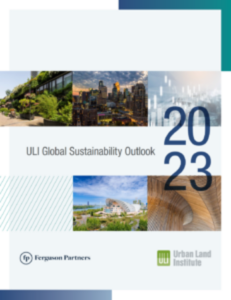
ULI Global Sustainability Outlook 2023
ULI Global Sustainability Outlook 2023 – an annual publication for ULI to share insights from member experts on the key ESG issues that will impact strategic real estate and land use decision making
Read the full report on ULI’s Knowledge Finder
Find the latest content and resources from ULI Australia, including the latest edition of Residential Development Review, and recordings of webinars and conferences from ULI District Councils around the globe, on ULI’s Knowledge Finder (exclusive to ULI members only).
